Multi-Channel Encoder Panels for IPTV Headends: How They're Organized
Once a headend needs to handle more than a couple of channels, standalone single-channel encoders often give way to rack-based, multi-channel encoder panels — chassis systems that consolidate many encoding channels into one manageable unit. Naming and specifics vary a lot by manufacturer, and terms like "PVI encoder," "card-based encoder" and "blade encoder" are all used to describe roughly this same category of product, but the underlying architecture is fairly consistent across vendors.
Understanding that shared architecture is more useful than memorizing any one vendor's specific product naming, because it lets you evaluate any multi-channel system on the fundamentals that actually determine whether it will serve your deployment well — regardless of which brand name happens to be on the chassis.
Why multi-channel panels exist
Running a dozen standalone encoders individually becomes unwieldy fast — more power connections, more points of failure, more individual devices to physically rack and cable, and no centralized management. A multi-channel panel consolidates several encoding channels into a single chassis with shared power, centralized management, and often shared cooling and monitoring, dramatically reducing the operational overhead of running many channels at once.
Beyond the pure convenience factor, consolidation also tends to reduce total power draw and rack space compared to the equivalent number of standalone units, which becomes a meaningful cost and space consideration once you're running enough channels for it to add up.
Typical architecture: cards and a chassis
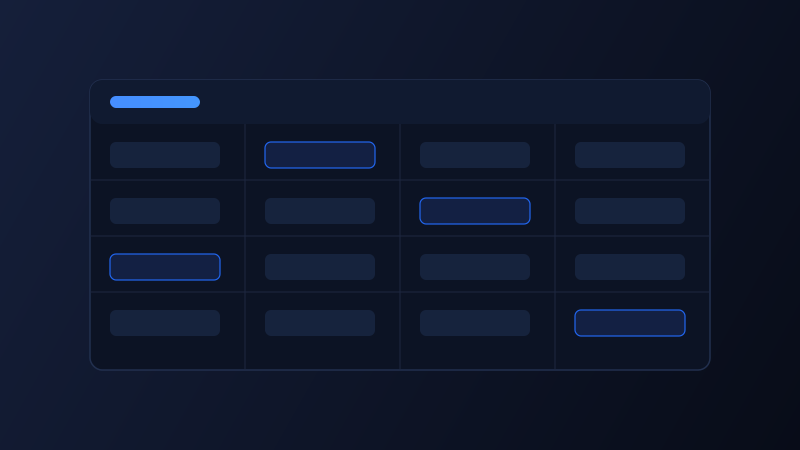
Many multi-channel systems use a modular design — a central chassis providing power, networking and management, with individual encoding "cards" or blades slotted in for each channel. This makes it straightforward to add capacity by inserting another card rather than deploying an entirely new standalone unit, and it lets a facility start with a partially populated chassis and grow into full capacity over time as budget and channel needs allow.
The chassis itself typically handles shared functions — power distribution, network switching, centralized configuration and monitoring — while each card handles the actual video-to-network encoding for its assigned input. This separation of concerns is what makes the modular approach so much easier to scale and maintain than a rack of independent standalone boxes.
Centralized management benefits
A key advantage of these panel systems is unified monitoring and configuration — checking the health and settings of many channels from a single interface rather than logging into each standalone encoder individually. For larger deployments, this operational simplicity often matters as much as the hardware consolidation itself, since it directly reduces the time engineers spend on routine health checks and configuration changes.
Centralized systems often also support features like bulk configuration profiles, unified alerting when a channel goes down, and consolidated firmware update management across every card in the chassis at once — capabilities that simply aren't practical to replicate across a rack of unrelated standalone devices.
When a multi-channel panel makes sense
If you're running more than a handful of channels, or expect to grow that number over time, a modular multi-channel system is usually more cost-effective and easier to manage long-term than accumulating standalone encoders one at a time. For one or two channels, a standalone encoder is typically simpler and more cost-effective, since the added complexity and cost of a chassis system isn't justified at that scale.
The crossover point varies by deployment and budget, but as a general guideline, facilities anticipating five or more channels — especially with expectations of further growth — tend to find the modular chassis approach pays for itself in reduced operational overhead within the first year or two of operation.
What to check when evaluating one
Confirm how many channels the chassis supports, whether cards can be added or replaced without taking the whole system offline (often called hot-swap capability), what output protocols each channel supports, and how centralized monitoring and alerting actually works — these operational details matter more day-to-day than raw channel capacity alone.
Also ask about redundancy options, since larger deployments often want redundant power supplies or the ability to fail over a card without losing the associated channel entirely. And confirm whether cards from different generations or capability tiers can be mixed within the same chassis, since that flexibility affects how easily you can upgrade specific channels without replacing the entire system.
Sizing a chassis for future growth
Because chassis systems are inherently modular, it's common practice to purchase a chassis with more slots than your immediate channel count requires, populating only the slots you need today and adding cards as requirements grow. This avoids the disruption of a full system replacement later, at the cost of a somewhat higher upfront investment in the chassis itself.
When sizing for growth, it helps to think a few years ahead rather than just the immediate project, since chassis systems are typically a longer-term infrastructure investment than standalone encoders. A facility that expects steady channel growth over time will generally get more value from over-provisioning slot capacity upfront than from repeatedly reaching capacity and needing to migrate to a larger system.
Power, cooling and rack space planning
A multi-channel chassis consolidates power and cooling requirements compared to an equivalent number of standalone units, but it also concentrates that demand into a single rack location, which needs to be planned for accordingly. Confirm your facility's power circuit capacity and cooling infrastructure can actually support a fully populated chassis at maximum channel density, not just the initial partial configuration.
It's also worth checking a chassis's physical rack unit height and weight before committing to a specific rack layout, particularly for facilities with existing space constraints — a highly capable chassis that doesn't physically fit your available rack space isn't a viable option regardless of how well it scores on every other criterion.
Vendor lock-in considerations
Since encoding cards for a modular chassis are typically proprietary to that specific chassis platform, choosing a multi-channel system does introduce a degree of vendor lock-in worth considering upfront. Once you've invested in a specific chassis platform, expanding capacity generally means buying more cards from the same vendor, which limits your future negotiating leverage compared to a mix of independent standalone units from different manufacturers.
This isn't necessarily a reason to avoid chassis-based systems — the operational benefits are often well worth it — but it's worth factoring vendor stability and long-term product roadmap into the decision alongside pure technical capability, since you're effectively committing to that vendor's platform for the life of the deployment.
As channel count grows, multi-channel encoder panels solve real operational problems that standalone units don't — centralized management, modular scaling, and consolidated infrastructure. Vendor terminology for these systems varies significantly, so evaluating based on architecture and management capability matters more than any specific product name or acronym.
Whether you call it a PVI encoder panel, a card-based chassis or a blade encoder system, the fundamentals to evaluate stay the same: channel density, hot-swap capability, centralized management quality, and room to grow. Getting those right matters far more than the specific vendor terminology on the spec sheet.
Once your channels are organized at the headend, our player software gives viewers a clean, reliable way to browse and watch the resulting lineup.
Architecture and management capability, not brand naming, are what actually determine how well a panel system will serve you as your channel count grows.
As with most decisions in this space, taking a few extra minutes to apply what's covered here about pvi encoder iptv tends to pay off well beyond the time it takes to read it.
If anything here about pvi encoder iptv still feels unclear, our team is glad to walk through the specifics of your own setup directly.
These same considerations around pvi encoder iptv tend to resurface any time your setup changes, so it's worth keeping this guide bookmarked for future reference.
Related on our site
Further reading
Quick FAQ
At what channel count does a multi-channel panel make sense?
There's no fixed number, but once you're managing more than a handful of standalone encoders, the centralized management and modular scaling of a panel system usually starts paying off.
Can I add channels to a multi-channel panel later?
Many modular systems support adding encoding cards over time, though this depends on the specific chassis having available slots and capacity.
Is a multi-channel panel more reliable than standalone encoders?
It depends on the design — consolidation can introduce a shared point of failure at the chassis level, which is worth weighing against the operational benefits of centralized management.
Do all multi-channel panels use the same terminology?
No, naming conventions vary significantly by manufacturer, which is why evaluating based on actual architecture and capability matters more than matching a specific term.
Ready to set up your own IPTV player?
View Pricing PlansReminder: use only legally licensed playlists and content sources. See our Legal & Responsible Use FAQ.